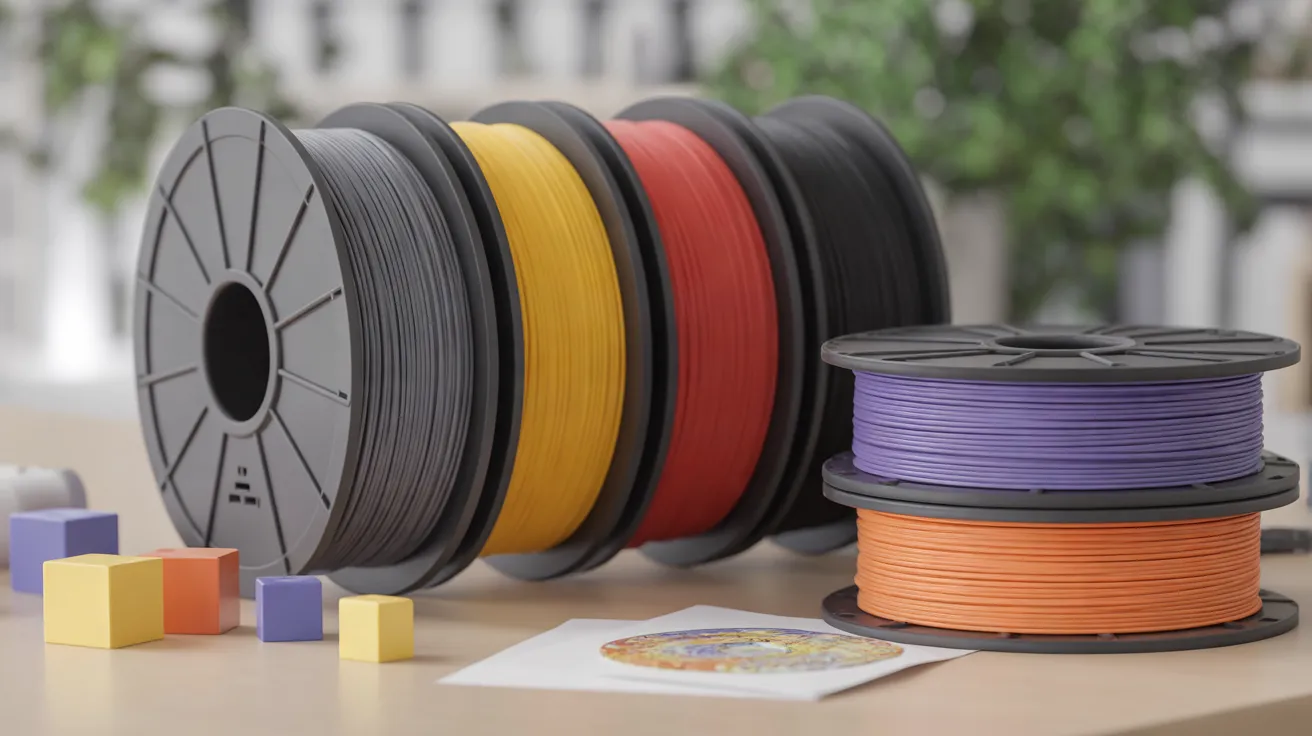
How we picked
We selected widely sold PLA filaments available to buy from major retailers or direct stores. We compared stated diameter tolerance, net spool weight, available colors, drying or sealing details, print temperature range, and price per kilogram.
Tip: If two PLA filaments are close, choose the one with tighter stated diameter tolerance and vacuum-sealed packaging with desiccant.
If you’re shopping for 3d filament pla, the difference between a smooth, glossy print and a stringy mess often comes down to one unglamorous detail: diameter consistency within ±0.02 mm. That tiny tolerance affects feed reliability, layer bonding, and whether your cute articulated dragon prints cleanly or turns into a spaghetti nest three hours in.
That matters even more in 2026 because most hobby printers now push faster default profiles than they did just a few years ago. A basic decorative print like the Cute Highland Cow Figure – 3D Printed PLA Decor or the Strawberry Bat Keychain – 3D Printed PLA Kawaii Bat Charm can look fantastic with the right spool, but fast travel moves and higher volumetric flow expose weak filament immediately.
Why the 7 Best PLA 3D Filaments in 2026 still come down to print reliability
The phrase 7 Best PLA 3D Filaments in 2026 sounds like a shopping list, but the real decision is more practical: which spool will actually work for your printer, nozzle, and model style. For display pieces, keychains, hand-painted collectibles, and small figurines, the best pla 3d printer filament usually wins on four things: low moisture uptake, predictable extrusion, neat color laydown, and clean support removal.
For most makers, PLA remains the easiest filament 3d printer pla users can start with because it prints at lower temperatures than ABS, warps less, and doesn’t usually require an enclosure. That’s why so many decorative models, including character charms and painted dinos, are still produced in 3d printing filament pla rather than tougher engineering plastics.
Here’s the short version:
- Best overall choice for most users: standard matte or silk pla filament for 3d printing with tight diameter tolerance and a recommended print range around 190–220°C
- Best for figurines and decor: low-stringing pla 3d printing filament with strong color opacity
- Best for beginners: spool lines marketed for easy bed adhesion and stable flow at moderate speeds
- Best for detail work: pla 3d print filament that handles 0.12–0.20 mm layer heights without blobbing
Which type of 3d filament pla works best for figurines, keychains, and display prints?
If you’re printing page-style items like a banana dragon, cactus dino, or a bat charm, surface finish matters more than raw strength. The best pla filament 3d printing option for those models is usually one of these three types:
- Standard PLA
- Best for: beginners, painted prints, clean dimensional accuracy
- Typical strengths: lower stringing, easier tuning, reliable first layers
- Best use: animal figures, planters, small shelf decor
- Matte PLA
- Best for: hiding layer lines on decorative models
- Typical strengths: softer-looking surface, excellent photo-ready finish
- Tradeoff: can be slightly more brittle than standard PLA
- Silk PLA
- Best for: eye-catching fantasy models and giftable display pieces
- Typical strengths: glossy finish with no paint required
- Tradeoff: often strings more and may need slower outer walls
If you want the shortest path to a good-looking print, standard PLA is still the safest pick in the 7 Best PLA 3D Filaments in 2026 conversation. It’s easier to tune than silk, and it usually preserves sharp corners better than softer matte blends.
What print settings give the best results with pla filament for 3d printers?
A lot of failed prints blamed on “bad filament” are really profile mismatches. Good pla filament for 3d printer can still underperform if you’re printing too hot, too fast, or with damp material.
Start with these practical ranges:
- Nozzle temperature: 195–215°C
- Most 3d printer pla filament performs best here.
- If you see stringing, drop by 5°C before changing retraction.
- Bed temperature: 50–60°C
- Enough for adhesion without making the base too soft.
- On textured PEI, some PLA works well even at 0–50°C.
- Print speed: 40–80 mm/s
- Decorative prints often look best around 50 mm/s outer walls.
- Faster than 100 mm/s can expose weak flow consistency.
- Part cooling: 80–100% after the first few layers
- Especially useful for ears, horns, wings, and keychain loops.
- Bridges improve dramatically with strong cooling on pla 3d filament.
- Retraction tuning
- Direct drive setups usually need less retraction than Bowden systems.
- Stringing on silk PLA often improves with 0.2–0.5 mm less retraction than you’d expect.
Pro tip: Drying PLA at around 40–50°C for 4–6 hours can rescue a spool that suddenly started popping or producing fuzzy strings. Even PLA, which is more forgiving than nylon, can absorb enough moisture to ruin fine details on miniature prints.
7 Best PLA 3D Filaments in 2026 by budget range and use case
Because prices move constantly, the smart way to compare the 7 Best PLA 3D Filaments in 2026 is by bracket rather than exact cost. For most hobbyists, the sweet spot is still mid-range filament with strong consistency and review history.
Best budget 3d printing pla filament options for everyday decorative prints
Budget PLA can absolutely work, especially for larger low-risk prints like test figures, planter shells, and simple desk decor. The key is avoiding ultra-cheap spools with poor winding, because crossed loops cause more failed prints than color variation ever will.
Look for these signs in entry-level pla filament 3d print options:
- Claimed diameter tolerance of ±0.02 mm to ±0.03 mm
- Vacuum-sealed packaging with desiccant
- Recommended temp window clearly printed on the spool
- Consistent user feedback mentioning easy first layers and low clogging
- Reel winding that looks even from edge to edge
Budget-grade pla 3d printer filament is often good enough for prototypes and painted models. If you’re sanding and priming a figurine anyway, perfect gloss and ultra-rich pigmentation matter less than reliable extrusion.
The mid-range sweet spot for 7 Best PLA 3D Filaments in 2026 shoppers
This is where most people should spend their money. Mid-tier pla filament for 3d printers usually gives you the best balance of color accuracy, lower failure rates, and fewer hours wasted tuning.
For decorative models, this bracket tends to deliver:
- Better spool winding
- More repeatable finish between color batches
- Cleaner support breakaway on tails, wings, and ears
- Less random brittleness after storage
- Stronger layer adhesion at moderate speeds
If you print collectibles similar to the Pineapple Dino 3D Printed Figure – Hand-Painted PLA Collectible or the Cute Bat Character Keychain – 3D Printed PLA Charm, this is the bracket that usually saves the most time. A cleaner spool means less sanding, fewer nozzle wipes, and fewer tiny surface scars on rounded details.
Premium pla filament 3d printer picks: are they worth the extra spend?
Premium pla 3d print filament earns its keep when the model is detailed, giftable, or sold to customers. You’re usually paying for tighter QC, more specialized pigments, and cleaner flow at higher speeds.
Premium can make sense if you need:
- Extremely uniform color on visible display parts
- Better consistency for batch printing
- Specialty finishes like extra-smooth matte or richer silk sheen
- Lower defect rates on long prints over 8–12 hours
That said, premium isn’t automatically necessary for every print. If you’re making test pieces, support-heavy prototypes, or children’s desk trinkets, a reliable mid-range pla filament 3d printer spool often gets you 90% of the result for noticeably less money.
What to look for before you buy pla filament for 3d printing
If you ignore the marketing words and focus on measurable traits, choosing pla filament for 3d printing gets much easier.
1. Diameter tolerance tighter than ±0.03 mm
This is one of the most important specs for smooth extrusion. Better 3d pla filament typically stays closer to ±0.02 mm, which reduces under-extrusion and random layer inconsistency.
2. Dry, sealed packaging
Fresh pla filament for 3d printer should arrive vacuum-packed with desiccant. If the bag seal looks weak or the spool feels brittle right away, moisture may already be a problem.
3. A usable temperature window, not just hype
You want a spool that clearly lists a print range like 190–220°C. Good pla filament 3d printing materials give you room to tune for detail or speed without becoming unstable.
4. Winding quality
Messy winding can snag mid-print and ruin a 6-hour model at layer 178. This matters more than most new users realize, especially with small decorative items that rely on uninterrupted outer walls.
5. Finish that matches the model’s purpose
- Matte: best for hand-painted figures and layer-line concealment
- Standard: best all-rounder for predictable pla filament 3d print
- Silk: best for dramatic gift pieces and shiny fantasy shapes
What review patterns usually signal trouble with pla 3d printing filament?
Reader reviews reveal the same failure patterns again and again. If a spool gets repeated complaints about brittle strands, tangles near the core, or random clogging, that’s not user error nine times out of ten.
Watch for these red flags:
- Frequent mentions of snapping filament
- Often a moisture or formulation problem
- Especially annoying on overnight prints
- Reports of inconsistent color between spools
- A major issue for multi-part decorative sets
- Visible on painted-adjacent prints where one section stays unpainted
- Many comments about nozzle jams at normal PLA temperatures
- Could indicate fillers, contaminants, or poor QC
- More common in novelty finishes
- Review average under roughly 4.2 stars over a large sample
- Usually where reliability complaints start stacking up
- Bad spools waste more money than they save
A similar “small spec, big outcome” pattern shows up in plenty of enthusiast categories, whether you’re comparing accessories at Ubuntuask or gear lists on Topdealsnet. Tiny material differences often create outsized real-world results.
Is 3d filament pla good for Etsy-style products and hobby selling?
Usually, yes. For charms, figurines, desk toys, and display pieces, pla 3d printing filament is still the most practical starting material because it prints cleanly, finishes well, and keeps failure rates manageable for small-batch production.
It works especially well for:
- Keychains and bag charms
- Hand-painted collectible figures
- Shelf decor
- Small planters for indoor use
- Cute fantasy animals and dinosaurs
For example, if you’re printing pieces similar to the Cactus Dino Figurine – Hand-Painted 3D Printed PLA or Strawberry Dinosaur 3D Printed PLA Figure, Hand-Painted, PLA gives you a smooth base for primer and acrylic paint. If your output is intended for hot cars, outdoor exposure, or high-impact use, though, PLA’s lower heat resistance becomes a real limitation.
Meanwhile, if you like comparing niche buying guides across categories, you’ll spot the same budget-versus-finish tradeoff on sites like Stlplaces, printable driver student sticker template, and even unique planner stickers collection.
What file types, slicer settings, and support choices work best with 3d printing filament pla?
The filament matters, but your workflow matters almost as much. Most decorative PLA models arrive as STL, 3MF, or occasionally OBJ files, and 3MF is usually the most convenient because it can store profile-related data more cleanly.
For typical 3d printing filament pla projects:
- Best file type for easy hobby printing: STL
- Best file type for richer project data: 3MF
- Typical layer height for figurines: 0.12–0.20 mm
- Wall count for small display models: 2–3 walls
- Infill for decor: 10–20%
- Supports: tree supports often reduce scarring on curved models
If you’re printing horns, tails, wings, or hanging loops, orient the part to minimize support on the most visible face. That matters more for glossy silk PLA, where support scars show up immediately.
For broader comparison rabbit holes, some readers bounce between unrelated resources like www.google.com and open link; in 3D printing, though, your slicer profile is still more important than almost any outside opinion.
So, what’s the single best way to choose among the 7 Best PLA 3D Filaments in 2026?
Start with standard PLA in the mid-range bracket, not the cheapest spool and not the fanciest finish. For most people printing decor, keychains, animals, and painted collectibles, the most important criterion is consistent extrusion with low stringing, because that affects every layer of every print more than color names or marketing claims ever will.
Frequently Asked Questions
what is pla 3d printer filament?
PLA is a common thermoplastic used in hobby and prosumer 3D printing because it melts at relatively low temperatures and is easy to print. What is pla 3d printer filament? It’s typically the first material people use for decorative parts, prototypes, figurines, and display models due to its low warping and clean surface finish.
what is the best pla filament for 3d printing
The best PLA filament for 3D printing is usually a mid-range standard PLA with tight diameter tolerance, dry packaging, and consistent user feedback on low stringing. For most users, reliability beats specialty finishes, especially if you print figurines, keychains, or painted decor.
3d printer filament pla vs abs
3d printer filament pla vs abs comes down to ease versus toughness. PLA is easier to print, warps less, and is better for visual models, while ABS handles heat and impact better but usually needs higher temperatures and an enclosure.
3d printer filament abs vs pla
3d printer filament abs vs pla is the same comparison from the opposite angle: ABS is better for functional parts exposed to stress or warmth, while PLA is better for beginners and decorative prints. If you care most about smooth results with fewer failed prints, PLA is usually the smarter starting point.
how to use a 3d pen with pla filament
To use a 3D pen with PLA filament, load the PLA strand, set the pen to a PLA-compatible temperature, and wait until the indicator shows it’s ready to extrude. Start with slow, short lines on a heat-safe surface because PLA cools quickly and becomes easier to control after the first minute or two.
No comments yet